
No. 3August 2026Montpellier, France
A theory of input, in praise of scattered curiosity
Got it. The next edition lands in your inbox.
Pause. Let’s step back and abstract. How can you outperform your competitors when everyone is using the same AI models?
By giving it a different input.
How?
Prompting, context, loop engineering: why these levers aren’t enough
Among the approaches we’ve all heard about:
- Writing / structuring prompts better. Yes, but this approach has now become commonplace, and the gains vary widely from task to task. The better AI gets at reasoning, the less value users get from explaining how it should go about the task.*1
- Giving it better context? Yes, but as this capability becomes standardized, it turns into a prerequisite rather than an advantage in itself. Context reduces the model’s ignorance; it guarantees neither accuracy nor distinctiveness. And accumulating more of it does not automatically produce better results.*2
- Loop engineering? Yes, but running an AI in a loop until it does its job gives you no direct advantage over your competitors, because they can do the same.*3
A model’s input begins with human direction
Upstream of the model, a human has, directly or indirectly, chosen the problem, selected the context, framed the objective, and defined what would count as a good answer.
Those choices establish a direction.
That direction is a product of the human mind: an output. It may take the form of a question, an angle, an intuition, a constraint, or an association.
For simplicity’s sake, let’s call that direction an “idea.”
What, then, makes a good idea to give an AI? Is it enough for an idea to be perfectly rational? To be based on common sense? To be the product of extensive professional experience?
I don’t think so.
When AI commoditizes standard expertise
This is where the mechanism flips.
An LLM is particularly powerful at developing, structuring, and rationalizing a direction that has already been formulated.
But this ability reduces the differentiating value of certain human qualities.
Consider two predictable inputs, meaning two directions that follow a line of reasoning familiar to the model.
- The first is a predictable, mediocre input: it follows an obvious line of reasoning but remains shallow and poorly structured.
- The second is a predictable, sophisticated input: it follows the same line of reasoning, but with greater precision, method, and expertise.
The difference between the two inputs is real, yet they will steer the model toward very similar outputs*4:
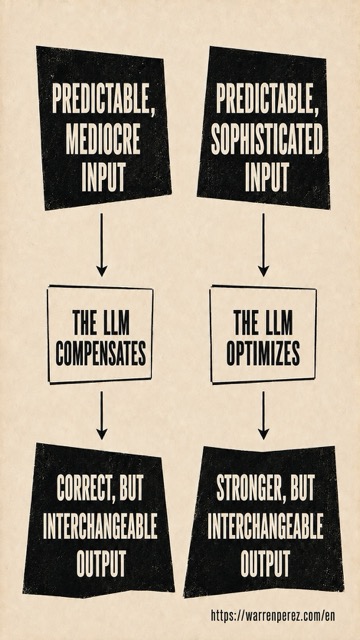
AI commoditizes what it can already reproduce, making it difficult to differentiate through mastery of a standard skill.
Conventions remain useful for getting things right. But if they determine the entire direction, they lead the model exactly where everyone expects it to go. Creating a difference requires introducing an association, experience, or perspective that the model would not have prioritized on its own.
You have to be unpredictable.
But unpredictability alone is not enough! An unusual element disconnected from the problem only leads to a ridiculous dead end: a result that is original and superficially coherent, but offers no value for the problem at hand. This difference becomes an advantage only when it helps us approach the problem differently while still solving it.*5
How can we encourage the emergence of unconventional ideas?
Human input: the raw material of unconventional ideas
The model’s input is partly the human’s output. But that output itself depends on everything a person has read, observed, experienced, felt, learned, or heard. All of these experiences gradually form a personal corpus: the raw material from which the mind draws to create new associations. The chain therefore does not begin in the prompt box. It begins with what feeds the person writing it.
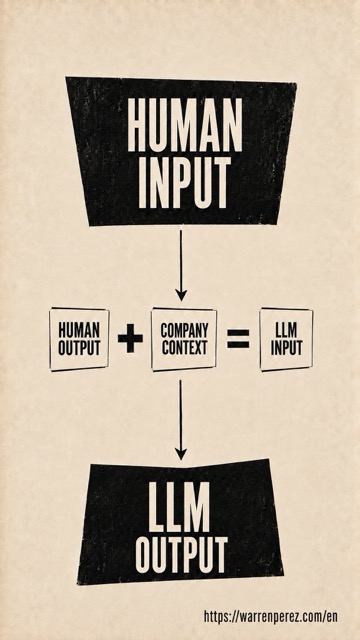
When this corpus is limited to the familiar references of a profession, a social milieu, or an era, the ideas that emerge from it are more likely to follow familiar paths. Conversely, knowledge from more distant fields multiplies the possible connections. Research on creativity points in the same direction. The associative theory of creativity describes new ideas as combinations of elements that may be far removed from one another. Actively engaging in unusual experiences can strengthen cognitive flexibility, while exposure to multiple cultures makes it easier to draw on less conventional knowledge.*6
The solution, then, seems to be… simply staying curious.
Curiosity as a rational strategy
Let’s stop treating curiosity as a personality trait reserved for a few. Instead, let’s see it as a stance we can cultivate, an impulse anyone can nurture and any organization can encourage. Curious people probably need no convincing. I’m speaking instead to those who have never found any practical use for it. Today, being curious is a pragmatic stance. As our work tools increasingly rely on probabilistic models, it becomes rational to deliberately introduce unpredictability into our inputs.
This stance leads us to seek information without yet knowing what it will be useful for, to follow a question that answers no urgent need, or to pay attention to what lies outside our expected path. Research shows that curiosity promotes learning and memory, including for information encountered incidentally. Exploratory curiosity is also associated with more original, higher-quality solutions, in part because it leads people to seek more information upfront.*7
Cultivating curiosity is not about frantically consuming ever more content. It is, rather, about taking seriously a subject whose usefulness is not yet apparent. It is an invitation to pay closer attention to our surroundings. To deliberately step outside the cultural repertoire expected of our profession, social milieu, or era. Spending a weekend trying to sew a bench cushion cover may seem entirely irrelevant to your work. Yet perhaps the experience will have given you a sharper eye for the seams in clothing. And that shift in perspective might generate a connection that no piece of strictly professional content would ever have suggested to you (or it might not).

Curiosity then becomes a sourcing strategy for the mind. It comes before the famous notion of “taste,” so abstract and, paradoxically, so widely celebrated. It renews the raw material from which unexpected connections can emerge, then be given to AI to develop.
There are also collective ways to encourage creativity. But that’s for another time. This edition is already quite long!
When everyone has access to the same models, the advantage goes to those who can give them a different world.
Notes and references
1. A meta-analysis of more than 100 publications found that Chain-of-Thought produced an average gain of 14.2 percentage points on symbolic tasks and 12.3 points in mathematics, compared with only 0.7 points in other categories. Across five software engineering tasks, advanced prompting techniques benefited newer models less and could sometimes degrade their performance. Sources: Sprague et al., ICLR 2025; Wang et al., ACM TOSEM 2026.
2. External context generally makes responses more specific and factual. Yet even when the context was deemed sufficient, GPT‑4o and Gemini 1.5 Pro still produced hallucination rates of 12.7% and 14.3%, respectively. On NoLiMa, 11 of the 13 models evaluated at 32,000 tokens fell below 50% of their short-context performance. Sources: Lewis et al., NeurIPS 2020; Joren et al., ICLR 2025; Modarressi et al., ICML 2025.
3. Loop engineering consists of designing loops in which an agent acts, observes the result, and adjusts its action. Research shows that self-correction depends primarily on reliable external feedback and that models may favor their own outputs when evaluating them. Across 2,200 texts, the collective diversity of human output grew two to eight times faster than that of GPT‑4. These studies support the mechanisms discussed here without directly measuring loop engineering in organizations. Sources: IBM, 2026; Kamoi et al., TACL 2024; Panickssery et al., NeurIPS 2024; Moon et al., 2025.
4. Among 5,172 customer-support agents, AI increased productivity by approximately 30% for less experienced workers, while effects were small for top performers. Another experiment involving 453 professionals found an average 18% increase in quality and a reduction in performance disparities. These findings support a compression effect, not a universal leveling of expertise. Sources: Brynjolfsson, Li and Raymond, QJE, 2025; Noy and Zhang, Science, 2023.
5. Creativity combines originality and effectiveness. An analysis of 17.9 million papers found that the most influential work generally combines a conventional foundation with an unusual association. A meta-analysis of 111 studies also found that certain constraints can foster creativity. These findings support the principle of an unconventional yet relevant element, without directly testing its application to LLM inputs. Sources: Runco and Jaeger, 2012; Uzzi et al., Science, 2013; Damadzic et al., 2022.
6. Epistemic curiosity engages neural circuits associated with reward anticipation and enhances memory. States of heightened curiosity also improve memory for incidental information, while diversive curiosity predicts the quality and originality of solutions through increased information seeking. Sources: Kang et al., Psychological Science, 2009; Gruber, Gelman and Ranganath, Neuron, 2014; Hardy, Ness and Mecca, 2017.
7. Associative theory describes creativity as the formation of novel combinations between sometimes distant elements. Two experiments also found that active engagement in unusual situations increases cognitive flexibility. Other research links multicultural experiences to the activation of less conventional knowledge and stronger creative performance. Sources: Mednick, Psychological Review, 1962; Ritter et al., 2012; Leung et al., American Psychologist, 2008.
Other editions
No. 2November 2025
AI and the Inevitable Full Power of Intention
No. 1September 2025