FrançaisEnglish (current)

Challenge

Working in silos: what if the problem lies in the system, not in your teams?

Working in silos describes an organization where each department moves forward with its own tools, its own data and its own priorities, while information fails to flow reliably to the others. Every department has its own truth. The company as a whole has none.

By Warren Perez, updated November 7, 2026

A note on method: the quotes on this page come from real conversations with clients we worked with between 2023 and 2026. They are anonymized and translated from French. The figures come from our published case studies.

1 · Definition

What does working in silos mean?

Working in silos means that each department operates in isolation: it has its own tools, its own files, its own rituals, and it shares with the others only what travels up the hierarchy or slips into a chat thread. The word comes from the grain silo, a sealed tower that stores grain without letting anything mix.

The image is accurate, with one difference. A grain silo is built on purpose. A company’s silos almost never are. They settle in layer by layer as the business grows: one department adopts a tool, another picks a second one, one team builds its own spreadsheet, the next team builds another. Nobody decided to wall anything off. The system simply grew that way.

“It’s not that they have trouble talking to each other, they’re in the same office, but the info just doesn’t flow as well as it should.”

a manager at a customer contact center

What are the types of organizational silos?

  1. The organizational silo

    It separates teams and their decisions. Anything that involves two departments goes up the hierarchy, or waits for a meeting.

  2. The data silo

    It locks information inside tools that don’t talk to each other. The same data lives in three versions, and none of them is the source of truth.

  3. The knowledge silo

    It keeps know-how in the heads of a few people. When they are away, everything on their subject stops.

Add to these the hierarchical silos, between levels, and the geographic ones, between sites or countries. In the organizations I work with, these are rarely separate problems: they are one and the same architecture, seen from different angles.

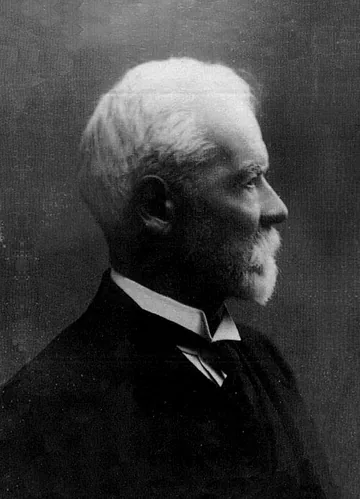
Portrait of Henri Fayol

Who was Henri Fayol?

Henri Fayol (1841-1925), a mining engineer, ran the Société de Commentry-Fourchambault et Decazeville for thirty years and saved it from bankruptcy. In 1916 he published Administration industrielle et générale, translated into English as General and Industrial Management, one of the first books to treat management as a discipline: five functions (planning, organizing, commanding, coordinating and controlling), fourteen principles, and the famous gangplank.

Photo: Wikimedia Commons

Fayol saw it in 1916: the gangplank

Henri Fayol, the French engineer regarded as one of the founders of modern management theory, was already describing the problem in his 1916 book, known in English as General and Industrial Management. In a hierarchy, two people in neighboring departments who need to coordinate send the information all the way up to their common boss, who then sends it back down. His answer takes a single horizontal line: a direct bridge between the two, with their superiors’ consent. Management textbooks know it as Fayol’s gangplank.

More than a century later, the question hasn’t changed: do your departments have direct bridges between them, or does everything go through the top?

What is the opposite of working in silos?

Synonyms
silo mentality, the silo effect, siloed teams, departmental silos
Related terms
information silos and data silos: the same architecture, seen from the IT side
The opposite
cross-functional collaboration: specialized departments connected by clear flows of information. Breaking down silos means building those flows.

2 · The signs

What are the signs of a siloed organization?

The signs of working in silos are repeated habits that everyone ends up treating as normal: the same information entered again and again, work redone without anyone knowing, questions asked instead of answers found, a leadership update that costs hours. Here are the ones I hear most often, in the words of the people who live with them.

Hover or tap an object on the mat to read the sign.

Work gets redone without anyone knowing.

“I worked on something for three weeks, and after a while I realize there’s actually a Notion page that already exists.”

a Customer Success lead at a scale-up

Every team has its own spreadsheet, and no two are alike.

“One of my people has a spreadsheet, the other one has a different spreadsheet. They never agreed on how to build the spreadsheet. Everyone does their own.”

the head of a group of health centers

The same information gets entered three times.

“You enter info that [a colleague] then has to re-enter in Notion, that we then re-enter in Trello, when we know it could be automated.”

the head of operations at a digital agency

People ask instead of finding.

“Everything goes through Slack, because you ask questions in threads, but you don’t even know who’s answering you.”

a Customer Success lead at a scale-up

The same topic exists in four versions.

“I see four pages created by the engineers, each one rehashing the same thing, distorted, on the same topic.”

a head of security at a scale-up

Meetings replace information.

“The reality is I spend at least five hours a day in meetings, even though I get in really early in the morning.”

the head of a production agency

Nobody sees anyone else’s workload.

“We don’t realize the graphic designers already have 15 things to get done by the end of the week.”

a marketing team at a large corporate group

The customer tells their story twice.

“There’s no connection being made between departments, so there are a lot of duplicates.”

a transportation startup of about thirty people

The leadership update costs hours.

In a group of several thousand people, every report to the executive committee required meetings and at least two hours of formatting.

3 · The test

Is your organization working in silos? Take the test

Eight situations, three answers each. Answer for your organization as it really works, not as the org chart describes it. Nothing is sent anywhere: your result appears right here, with the reading organization theory would give it.

  1. A piece of customer information changes. How many times is it entered before it is up to date everywhere?
  2. Two departments need to agree on a shared issue. Where does the decision go?
  3. A project moves from one team to another. How does the handoff happen?
  4. How many tools are used to track projects across the company?
  5. Someone goes on vacation. Their work…
  6. Leadership wants the status of every project for the executive committee.
  7. Your teams’ objectives are set…
  8. Your internal search tool, or your AI agent, has to answer a question that involves several departments.

How to read your score

0 to 4 points: A connected organization
Your teams have their own ways of working and a shared view. It is the balance Paul Lawrence and Jay Lorsch described at Harvard in 1967: high differentiation and high integration. The work now is to keep that balance as you grow.
5 to 10 points: Silos taking hold
Growth is stacking up tools faster than it connects them. Your gangplanks, in Henri Fayol’s sense, still exist, but they depend on a handful of people. Now is the time to design them, before they design themselves in your chat threads.
11 to 16 points: A siloed organization
Your departments talk through the hierarchy and through chat. Melvin Conway put it as early as 1968: organizations design systems that mirror their own communication structure. A team-building retreat won’t fix that. What fixes it is redesigning how information flows.

4 · The causes

Why do departments end up working in silos?

Departments end up working in silos because of four mechanisms that growth adds together: tools stacked up faster than they are connected, objectives set by department, handoffs nobody designed, and specialization that has turned into isolation. Rarely for lack of goodwill. As one team lead told me: “I don’t think the teams are hiding, that’s not it at all.”

1Growth stacks up tools faster than it connects them

Each department picks the tool that suits it, at the moment it needs one. Taken one by one, these choices are reasonable. Put end to end, they draw a company where information lives in several side-by-side systems that don’t talk to each other.

In 1968, computer scientist Melvin Conway stated the law that now bears his name: organizations design systems that mirror their own communication structure. The reverse holds true as well: siloed tools end up siloing the teams that use them.

“Today we use Dropbox, Evernote, Excel, Google Docs, Google Sheets. With all these tools we manage to do good things, but it’s never complete and we lose time.”

the head of a small business

2Objectives set by department, never by flow

When each department is judged on its own results, it optimizes its own scope. That is normal, and human. Value, however, is created in the flows that cut across departments: a quote that becomes a project, a request that becomes a deliverable, a product that reaches production with all its supporting materials. These flows often have no owner.

3Handoffs nobody designed

Silos show most clearly at the borders: between production and post-production in an agency, between the design office and marketing at a manufacturer, between the team that sells and the team that delivers, between support and the developers. When a handoff has no structure, it relies on memory, a message or a meeting. And information gets lost along the way.

“He creates a Notion thing, maybe, if he does his job right and he’s really conscientious. But, well, we’re not super automated.”

an executive at a SaaS company, on support tickets

4Specializing does not mean isolating

Specialization and silos are not the same thing. Specialization has real advantages: expertise, focus, clear responsibilities. Some separation is even healthy, when information needs to stay confidential. In 1967, Paul Lawrence and Jay Lorsch showed that the best-performing organizations are not the least specialized: they combine high differentiation between departments with high integration of their work.

Each department can keep its own databases and specialist tools, as long as it shares at least one common view. Breaking down silos doesn’t mean making everyone the same.

Warren Perez

5 · The cost

How much does working in silos cost?

Working in silos costs time, money and missed commitments: ineffective communication accounts for 56% of the project budget at risk, according to the Project Management Institute, and searching for information takes up nearly one day a week, according to McKinsey. These costs stay invisible because they dissolve into daily work. Yet they can be measured.

What serious research says

  • 9%of managers say they can rely on colleagues in other functions “all the time,” while 84% can rely on their boss and direct reports all or most of the timeHarvard Business Review, Sull, Homkes and Sull, March 2015
  • 56%of the money at risk on projects is at risk because of ineffective communication, which causes one project in five to failProject Management Institute, Pulse of the Profession, May 2013
  • 47%of employees struggle to find the information they need to do their jobsGartner, survey of 4,861 employees, May 2023
  • 20%of a knowledge worker’s week, roughly, goes to searching for internal information or tracking down the right colleagueMcKinsey Global Institute, “The social economy,” July 2012

What we measured with our clients

OrganizationWhat changedBeforeAfter
Confidential clientFuneral services groupThe executive committee report2 hours of formatting1 click, updated in real time
Nematis360° digital agencyA quote and its project45 to 60 minutes5 minutes, no re-entry
DC GroupeIndustrial groupA new productsteps forgotten between departments61 steps launched in one click
Confidential clientFintech scale-upQuestions to the People teama wiki more than 70% out of datehalf as many requests
SPOACreative agencyAn agency’s productionbriefs lost in chat threads7 teams in a single system
GetaroundCar-sharing platformKnowledge after a mergereach team with its own referencesone knowledge base, in two languages

Estimate the cost in your organization

Three settings are enough for an order of magnitude. Nothing is sent anywhere: the calculation happens right here.

$100,000

per year, in time lost re-entering, searching for or redoing work

or the equivalent of 1.0 full-time position

This cost can come down. Let’s talk about it.

Send an inquiry

How it is calculated: people × hours lost per week × 48 working weeks × fully loaded hourly cost. The fully loaded cost is the annual salary divided by 0.70, because wages and salaries make up 70% of employer compensation costs in US private industry (Bureau of Labor Statistics, Employer Costs for Employee Compensation, June 2026), spread over a 1,920-hour working year (48 weeks of 40 hours). Twenty people who each lose two hours a week, at an average salary of $70,000, cost $100,000 a year, the equivalent of one full-time position.

6 · The way out

How do you break down silos?

To break down silos, redesign how information flows between departments: map the real flows, set one source of truth for each piece of information, design the bridges and put lasting governance in place. Neither a team-building retreat nor a reorganization is enough. It is the core of my work as a transformation partner, and it always follows the same path.

Hover or tap a step to open it.

Step 1

Map the real flows, not the org chart

We meet every team and follow the real path of information: who creates it, who re-enters it, where it gets lost. We map the system before touching a single tool, and along the way we measure what the silo costs: coordination time, duplicate entry, questions asked twice.

At the funeral services group, ten interviews brought to light flows the org chart did not show.

Step 2

One single source of truth for each piece of information

Each piece of information has one place where it is the reference, and an owner. Teams read it in their own view, without copying it, in tools like Notion connected through automation. Each team keeps its own way of working: we connect what needs connecting and leave the rest alone. Adding a tool is rarely the answer, when what is often needed is one tool fewer.

At Nematis, the brief is entered once, and each specialist reads it in their own way.

Step 3

Design the bridges

At the borders between departments, we design clear handoffs: who passes what, at what moment, in what form. We connect silos rather than tear them down: a reorganization often just moves the problem, bridges solve it.

At DC, every new product automatically launches the 61 steps that connect the design office, marketing, procurement and production.

Step 4

Governance that holds over time

Owners, review dates, a few simple rituals. Without them, old habits come back at the first unexpected event. And what was measured before gets measured after.

At DC, the rule fits in one sentence: every Friday, everyone updates the system before leaving.

7 · AI

Can AI break down silos?

No. Plugging AI into a siloed organization does not break down its silos: it inherits them, and often amplifies them. An AI agent answers with the sources it is given. If those sources are scattered, contradictory or outdated, so are its answers, only with more confidence.

The fintech scale-up I worked with learned this firsthand. “It’s going to give me an analysis based on a doc from 2019, and it’s combined with a doc from 2024,” an operations manager summed up. Its AI agent was drawing on a wiki more than 70% out of date. Once the knowledge was restored to a single source, governed and up to date, its answers became 80% more reliable. At SPOA, AI now works from a complete base, with the agency’s real context.

We always start by reducing operational noise, before amplifying anything with AI. Breaking down silos is the condition for AI to serve your way of doing things, rather than dilute it.

Warren Perez

8 · The cases

They stopped working in silos

Six organizations, six different silos, one approach.

“Fred, who has been at DC for 16 years, told me about the documentation: I can’t even remember how I used to do it before.”

a communications and marketing lead at an industrial group

See all 18 case studies

Where to start

Start with a flow that is costly and visible: the request that changes hands three times, the report that takes half a day. That is where proof arrives fastest. If you would like to talk it through, tell me about it below.

Let’s talk about your project.

Tell me a little about what you’re working on. I’ll get back to you personally to discuss the next steps.

Preferred contact method Optional

Your details are only used to reply to you (legal notices).

Sources

  1. Henri Fayol, Administration industrielle et générale, Dunod, 1916. English translation: General and Industrial Management, Pitman, 1949.
  2. Paul R. Lawrence and Jay W. Lorsch, Organization and Environment: Managing Differentiation and Integration, Harvard University, 1967.
  3. Melvin E. Conway, “How Do Committees Invent?” Datamation, April 1968.
  4. Donald Sull, Rebecca Homkes and Charles Sull, “Why Strategy Execution Unravels, and What to Do About It,” Harvard Business Review, March 2015.
  5. Project Management Institute, Pulse of the Profession In-Depth Report: The High Cost of Low Performance: The Essential Role of Communications, May 2013.
  6. Gartner, “Gartner Survey Reveals 47% of Digital Workers Struggle to Find the Information Needed to Effectively Perform Their Jobs,” press release, May 10, 2023 (Digital Worker Experience Survey, 4,861 respondents).
  7. McKinsey Global Institute, The social economy: Unlocking value and productivity through social technologies, July 2012.